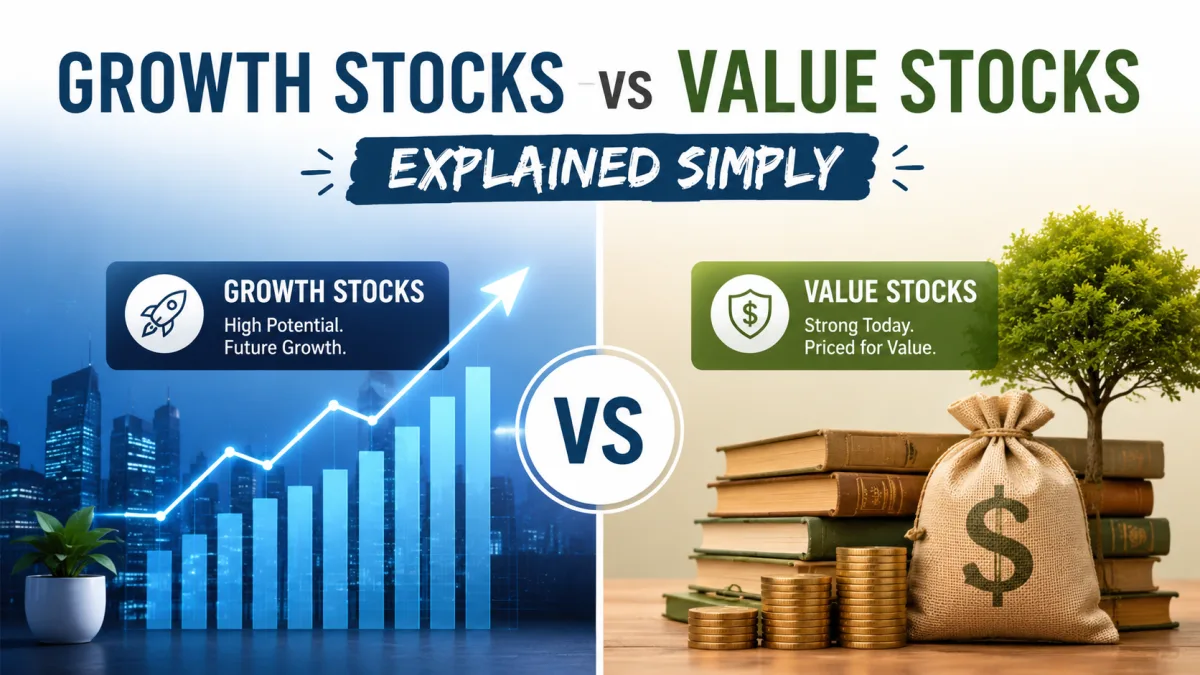
The Growth-Value Divide: How Investors Balance Ambition and Discipline
Every investor eventually meets the same question: should I buy growth stocks or value stocks?
The question sounds simple, but it reaches into one of the deepest debates in investing. Growth investing is built around the future. It asks what a company could become if revenue expands, profits rise, markets widen, and innovation succeeds. Value investing is built around price and discipline. It asks whether the market is underestimating a company’s real worth today.
Both strategies can build wealth. Both can disappoint investors who misunderstand them. Growth stocks can rise dramatically when expectations are met, then fall sharply when enthusiasm fades. Value stocks can provide stability and income, yet remain cheap for years if the business is weaker than it appears.
The smartest investors do not treat growth and value as slogans. They understand that these approaches are different ways of thinking about business, price, risk, and time. A growth investor is not simply buying expensive stocks. A value investor is not simply buying cheap stocks. In both cases, the quality of judgment matters more than the label.
To understand the difference, investors must look beyond stock market categories and ask a better question: what am I actually paying for, and what must happen for this investment to succeed?
What Growth Stocks Really Are
Growth stocks are shares of companies expected to increase revenue, earnings, cash flow, or market share faster than the average business. Investors buy them because they believe the company’s future will be much larger than its present.
A growth company may be expanding into a large market, disrupting an old industry, creating new technology, building a powerful brand, or scaling a business model with unusually high profit potential. These companies often reinvest heavily. Instead of returning large amounts of cash to shareholders through dividends, they use capital to hire employees, build products, acquire customers, expand infrastructure, enter new regions, or fund research and development.
This reinvestment is central to the growth stock story. A company that can reinvest money at high rates of return may create far more long-term value by keeping profits inside the business than by paying them out. For that reason, many growth stocks pay little or no dividend. Investors accept limited current income because they expect future business expansion to drive stock price appreciation.
Growth stocks are often associated with technology, artificial intelligence, cloud computing, e-commerce, digital payments, biotechnology, medical innovation, cybersecurity, software, electric vehicles, and other industries tied to rapid change. But growth is not limited to modern technology. A restaurant chain expanding nationally, a luxury brand gaining global demand, a healthcare company launching a breakthrough treatment, or a logistics firm scaling efficiently may also be a growth company.
The defining feature is not the industry. The defining feature is expectation. Investors believe the company can become significantly larger, more profitable, or more dominant over time.
What Value Stocks Really Are
Value stocks are shares of companies that appear to trade for less than their underlying worth. Value investors look for situations where the market price seems too low compared with earnings, assets, cash flow, dividends, brand strength, or long-term business value.
A value stock may be a mature company with stable profits. It may be temporarily unpopular because of disappointing results, negative headlines, industry weakness, recession fears, or investor neglect. It may operate in a boring sector that attracts less attention than fast-growing industries. It may pay dividends and generate steady cash even if its growth rate is modest.
Value investing begins with the idea that markets are not perfectly rational at all times. Investors can become overly excited about fashionable companies and overly pessimistic about unfashionable ones. Prices can move away from business reality. A value investor tries to buy when pessimism has pushed the price below a reasonable estimate of worth.
This does not mean value investors buy any stock that has fallen. A low price alone is not enough. A stock may be cheap because the business is deteriorating, debt is too high, profits are shrinking, management is weak, or the industry is in long-term decline. A true value opportunity exists when the market price is low relative to the company’s durable earning power or assets, not merely because the stock has declined.
Value investing is often associated with lower price-to-earnings ratios, lower price-to-book ratios, stronger dividend yields, stable cash flows, and more established businesses. But once again, the label can be misleading. The real question is whether the investor is paying less than the business is reasonably worth.
The Core Difference: Paying for the Future vs Buying the Present at a Discount
The simplest distinction is this: growth investors often pay a higher price today because they expect the future to be much better; value investors seek a lower price today because they believe the market is underappreciating what already exists.
A growth investor may buy a company trading at a high valuation because current profits do not reflect future potential. The company may be spending heavily now to build a platform, product ecosystem, or customer base that could become extremely profitable later. The investment depends on expansion.
A value investor may buy a company trading at a low valuation because current pessimism seems excessive. The company may already have assets, earnings, dividends, or cash flow that justify a higher price. The investment depends on recognition, recovery, stability, or patient income.
Growth investing often asks, “How large can this company become?” Value investing often asks, “What is this company worth compared with the price I am paying?”
Both questions are important. A company can be growing quickly but still be a poor investment if the price already assumes perfection. A company can be cheap but still be a poor investment if its future is permanently impaired. Successful investing requires both imagination and discipline.
Why Growth Stocks Often Trade at Higher Valuations
Growth stocks usually trade at higher valuations because investors expect future earnings to be much larger than current earnings. Valuation ratios such as price-to-earnings, price-to-sales, or price-to-free-cash-flow may look expensive when judged only by present numbers.
That does not automatically mean the stock is overvalued. A company growing revenue rapidly may deserve a higher valuation than a stagnant company. If profits are likely to rise dramatically, today’s expensive-looking price may appear more reasonable in hindsight.
The danger is that high valuations leave little room for disappointment. When a stock price already reflects optimistic assumptions, even a minor slowdown can cause a sharp decline. Growth stocks are priced on expectations. If expectations fall, the valuation can compress quickly.
Imagine a company growing revenue at 40 percent per year. Investors may assign it a high valuation because they expect years of rapid expansion. If growth slows to 20 percent, the business may still be healthy. But the stock can fall if investors had priced it for 40 percent growth. The company did not fail. The expectations changed.
This is one of the most important lessons in growth investing. A great company is not automatically a great stock at any price. The investor must consider how much future success is already reflected in the share price.
Why Value Stocks Often Trade at Lower Valuations
Value stocks often trade at lower valuations because investors have doubts. Those doubts may be temporary or justified.
A company may be facing a cyclical downturn. Earnings may be depressed because the economy is weak, commodity prices have fallen, consumers are cautious, or interest rates have changed. If the business can recover, the low valuation may create opportunity.
A company may be overlooked because it operates in a slow-moving industry. It may not attract headlines, but it may produce reliable cash flow year after year. Investors seeking excitement may ignore it, allowing patient buyers to acquire shares at sensible prices.
A company may also be cheap because it deserves to be cheap. Its products may be losing relevance. Its debt may be dangerous. Its margins may be shrinking. Its management may have destroyed trust. Its industry may be in structural decline. In that case, the low valuation is not an opportunity. It is a warning.
This is why value investing requires judgment. The investor must distinguish between temporary unpopularity and permanent impairment. A temporarily unpopular company can be rewarding. A permanently weakening company can become a value trap.
The Value Trap: When Cheap Becomes Expensive
A value trap is a stock that appears cheap but continues to decline because the business keeps deteriorating. Beginners are especially vulnerable to value traps because low valuation ratios can look comforting.
A stock trading at a low price-to-earnings ratio may seem safer than a high-growth stock. But if earnings are about to collapse, the valuation is misleading. A stock trading below book value may look attractive. But if the assets are worth less than reported or cannot generate returns, the discount may be justified. A high dividend yield may look appealing. But if cash flow cannot support the dividend, a cut may follow.
Value traps often occur when investors focus on historical numbers while ignoring future business reality. A retailer may look cheap based on past profits, but if customers are permanently shifting online and the company has no effective response, the past is not a reliable guide. A media company may appear inexpensive based on old cash flows, but if its audience and advertising power are eroding, the low price may still be too high. A bank may look cheap during a credit cycle, but hidden loan losses can change the picture quickly.
The lesson is clear: cheapness is not value. Value exists only when the price is low compared with realistic future worth.
The Growth Trap: When Ambition Becomes Overpayment
Growth investing has its own trap. A growth trap occurs when investors pay too much for an exciting company, assuming rapid expansion will continue without interruption.
Growth stories are powerful because they are easy to imagine. A company may have a visionary founder, a large addressable market, impressive revenue growth, and a product that feels important. Investors begin to project success far into the future. The stock price rises. More investors join. The valuation becomes detached from realistic outcomes.
Then growth slows. Competition increases. Customer acquisition costs rise. Margins disappoint. Regulation appears. Management makes mistakes. Capital becomes more expensive. The stock falls not because the company vanished, but because the market expected too much.
This is the central risk of growth investing. Investors can be right about the business and still wrong about the stock if they overpay. A company may double revenue, become more profitable, and continue operating successfully, yet the stock may disappoint if the original valuation assumed even more.
Growth investing requires imagination, but imagination must be anchored by valuation. Without discipline, growth investing becomes storytelling.
How Market Cycles Affect Growth and Value
Growth and value stocks often perform differently across market cycles. There is no permanent winner. Leadership changes as interest rates, inflation, economic growth, investor sentiment, and corporate earnings shift.
Growth stocks often perform well when interest rates are low, capital is abundant, and investors are willing to pay for future earnings. Low rates can make distant profits appear more valuable in present terms. Optimistic markets also tend to reward companies promising rapid expansion.
Value stocks may perform better when investors become more cautious, inflation rises, interest rates increase, or markets favor current cash flow over distant expectations. Companies with profits today, dividends today, and tangible assets today can become more attractive when uncertainty increases.
Economic expansions may benefit both groups, but in different ways. Growth stocks may gain from rising demand and investor optimism. Value stocks may recover if cyclical industries rebound, credit conditions improve, or depressed earnings normalize.
During downturns, the results vary. Some growth stocks fall sharply because investors reduce risk and question future projections. Some value stocks hold up better because valuations were already low and dividends provide support. But this is not guaranteed. Value stocks in economically sensitive sectors can also suffer severe declines during recessions.
The important point is that growth and value move in cycles. Investors who chase whichever style performed best recently may arrive late. A balanced strategy can reduce the need to predict which style will lead next.
Growth Stocks and the Power of Compounding
The appeal of growth investing is the possibility of business compounding. A company that can reinvest capital at high returns for many years can create extraordinary shareholder wealth.
Compounding occurs when gains generate more gains. In a business, this can happen when profits are reinvested into expansion, which produces more profits, which fund more expansion. A company with a large market opportunity and strong competitive advantages may compound value for a long time.
Consider a software company that spends heavily to build its product and acquire customers. In the early years, profits may be small because the company is investing aggressively. But if customers remain loyal, revenue recurs, and the product becomes essential, the company may eventually produce high margins. Early investors may benefit from the shift from investment phase to profit phase.
This is why growth investors study market size, customer retention, pricing power, unit economics, margins, and management quality. They are trying to identify companies that can grow without destroying shareholder value.
Not all growth is good growth. A company can grow revenue while losing money on each customer. It can expand quickly by spending too much on marketing. It can enter new markets without durable advantage. It can grow for growth’s sake. Investors must ask whether growth creates value or merely creates activity.
Value Stocks and the Power of Repricing
The appeal of value investing is the possibility of repricing. If a stock trades below fair value and the market eventually recognizes its worth, investors can benefit as the price rises.
Repricing can happen for several reasons. Earnings may recover. Management may improve operations. A company may sell assets, reduce debt, increase dividends, repurchase shares, or attract an acquisition offer. Investor sentiment may shift. A sector that was unpopular may regain favor.
Value investing can also generate returns through income. Many value stocks pay dividends. Even if the stock price takes time to recover, investors may receive cash while waiting. This can make value investing psychologically easier for some investors, though dividends are never guaranteed.
Value investing requires patience because the market may take years to recognize value. A stock can remain undervalued longer than expected. The investor must have enough conviction to wait, but enough humility to admit when the original thesis was wrong.
This balance is difficult. Holding through temporary neglect is wise. Holding through permanent decline is costly. The skill lies in knowing the difference.
Key Metrics for Growth Investors
Growth investors often look at revenue growth first. Rapid revenue growth suggests rising demand, expanding market share, or successful product adoption. But revenue alone is not enough.
Gross margin matters because it shows how much profit remains after the direct cost of delivering a product or service. High gross margins may indicate pricing power, scalability, or a valuable business model.
Operating margin matters because it shows whether the company can turn revenue into operating profit after expenses such as sales, research, administration, and development. Some growth companies intentionally operate at low margins while expanding. The investor must decide whether margins can improve later.
Free cash flow matters because it reveals whether the business can generate cash after necessary investments. A company can report accounting profits while consuming cash, or report losses while building a model that may later generate significant cash. Understanding the difference is essential.
Customer retention matters for subscription, software, and service businesses. A company that keeps customers for many years may have a stronger growth engine than one that constantly needs to replace departing customers.
Total addressable market matters, but investors should treat it carefully. Large market estimates can make almost any growth story sound attractive. The better question is not only how large the market is, but how much of it the company can profitably capture.
Key Metrics for Value Investors
Value investors often begin with valuation ratios. The price-to-earnings ratio compares the stock price with earnings per share. A lower ratio may suggest the stock is cheaper, but only if earnings are sustainable.
The price-to-book ratio compares the market value with the accounting value of net assets. It can be useful for banks, insurers, and asset-heavy businesses, but less useful for companies whose value comes from brands, software, networks, or intellectual property.
The dividend yield shows income relative to price. A higher yield can be attractive, but it must be supported by cash flow.
Free cash flow yield compares free cash flow with market value. It helps investors evaluate how much cash the business produces relative to the price being paid.
Debt ratios are especially important in value investing. A company may look cheap because equity investors are worried creditors will capture much of the value. High debt can limit flexibility, force asset sales, restrict dividends, or increase bankruptcy risk during downturns.
Return on invested capital helps investors judge business quality. A cheap stock with poor returns on capital may deserve a low valuation. A reasonably priced company with strong returns may be more attractive than an extremely cheap company with weak economics.
Quality Matters More Than the Label
Investors often argue about growth versus value as if the categories alone determine success. They do not. Quality matters more.
A high-quality growth company has a large opportunity, strong competitive advantages, capable management, improving profitability, and a reasonable path to cash generation. A low-quality growth company has a story but no durable economics.
A high-quality value company has stable or recoverable earnings, manageable debt, real cash flow, shareholder-oriented management, and a price below reasonable worth. A low-quality value company is cheap because it is deteriorating.
The best investments often combine elements of both. A company may be growing and undervalued. Another may be mature but still capable of steady growth. A dividend-paying company may also expand earnings. A technology company may become a value stock after a market decline if its fundamentals remain strong and the price becomes attractive.
Labels are useful for education, but investing reality is more nuanced. The investor’s job is not to join a camp. The job is to make intelligent decisions with capital.
Dividends: More Common in Value, But Not Exclusive
Value stocks are more likely than growth stocks to pay dividends because many value companies are mature businesses with established cash flows. They may not have enough high-return reinvestment opportunities to justify keeping all profits. Returning cash to shareholders becomes a rational choice.
Growth stocks often pay little or no dividend because management believes reinvesting cash can create more value. Investors accept this because they hope the company’s future share price will compensate them.
Neither approach is automatically superior. A company should pay dividends when it has excess cash that cannot be reinvested at attractive returns. A company should retain earnings when it can reinvest them productively. Problems occur when companies do the wrong thing.
A growth company that keeps raising capital without a clear path to profit may dilute shareholders. A mature company that refuses to return cash despite limited growth opportunities may waste money on poor acquisitions. A company that pays dividends it cannot afford may weaken its balance sheet.
Dividend policy is part of capital allocation. Good management teams understand when to reinvest, when to return cash, and when to preserve financial flexibility.
Volatility and Investor Temperament
Growth stocks are often more volatile than value stocks. Their prices depend heavily on future expectations, and expectations can change quickly. A single earnings report, product delay, regulatory concern, or shift in interest rates can cause major price movement.
Value stocks may be less volatile in some periods because expectations are lower and valuations are more grounded in current earnings or assets. But value stocks can still be volatile, especially in cyclical industries such as energy, financials, materials, manufacturing, and real estate.
Investors should choose strategies that match their temperament. A person who panics during sharp declines may struggle with concentrated growth investing. A person who becomes impatient when stocks move slowly may struggle with value investing. A person who constantly chases recent winners may struggle with both.
The best strategy is not only the one with the highest theoretical return. It is the one the investor can follow through difficult markets. Behavior can destroy returns faster than strategy selection.
How Interest Rates Influence Growth and Value
Interest rates affect how investors value future cash flows. Growth companies often expect a larger share of their profits to arrive far in the future. When interest rates are low, those future profits may appear more valuable. When rates rise, distant profits may be discounted more heavily, which can pressure growth stock valuations.
Value companies often produce more current earnings and cash flow. They may be less dependent on distant expectations. In periods of rising rates, some value stocks can become relatively more attractive, especially if they have strong balance sheets and pricing power.
But the relationship is not mechanical. Higher rates can hurt value stocks too, particularly companies with heavy debt or interest-sensitive business models. Banks may benefit from certain rate environments but suffer in others. Real estate firms may struggle when financing costs rise. Utilities may face pressure because investors compare dividend yields with bond yields.
Interest rates are one reason leadership rotates. A strategy that thrives in one environment may lag in another. Investors who understand this are less likely to abandon a sound plan after a temporary period of underperformance.
Growth Investing Requires Belief, But Not Blind Faith
Growth investors need belief. They must see what a company may become before it is obvious in the financial statements. They must tolerate uncertainty, reinvestment, volatility, and criticism from investors who think the valuation is too high.
But belief must not become blind faith. A growth thesis should be tested against evidence. Is revenue growth durable? Are customers staying? Are margins improving or capable of improving? Is the company gaining market share profitably? Is competition intensifying? Is management honest about risks? Does the balance sheet provide enough runway?
Growth investing fails when investors fall in love with stories and ignore numbers. A compelling narrative can raise capital and attract attention, but long-term returns eventually depend on economics.
The best growth investors are optimistic but demanding. They believe in innovation, but they require proof that innovation can become profitable ownership value.
Value Investing Requires Patience, But Not Stubbornness
Value investors need patience. They often buy when a company is unpopular. They may look wrong for months or years. The market may continue favoring faster-growing companies while their holdings remain overlooked.
But patience must not become stubbornness. A value thesis should also be tested against evidence. Are earnings stabilizing? Is debt manageable? Is cash flow real? Is management improving capital allocation? Is the industry recovering or declining? Is the dividend safe? Is the market wrong, or is the business worse than expected?
Value investing fails when investors refuse to admit that cheap stocks can get cheaper for good reasons. A low price is not a shield against business decline.
The best value investors are disciplined but flexible. They demand a margin of safety, but they update their thinking when facts change.
The Margin of Safety
Margin of safety is one of the most important concepts in value investing, but it applies to all investing. It means buying with enough room for error that the investment can still work if the future is not perfect.
In value investing, margin of safety often comes from paying a price below estimated intrinsic value. If a business is worth $100 per share and an investor buys at $70, the discount provides protection against mistakes in the estimate.
In growth investing, margin of safety may come from business quality, balance sheet strength, recurring revenue, market leadership, or buying during periods when expectations have become more reasonable. Growth investors still need protection from over-optimism.
No margin of safety is perfect. An investor may estimate value incorrectly. A business may deteriorate. A crisis may change the outlook. But the principle remains essential: do not build an investment case that requires everything to go right.
ETFs and Funds for Beginners
Beginners do not need to pick individual growth or value stocks immediately. Exchange-traded funds and mutual funds can provide diversified exposure to both styles.
A growth ETF may hold companies with higher expected earnings growth, stronger momentum, or exposure to innovative industries. A value ETF may hold companies with lower valuation ratios, higher dividend yields, or stronger current cash flows. Broad market index funds often include both growth and value companies in one portfolio.
Funds can reduce company-specific risk. Instead of depending on one stock, the investor owns a basket. This can be especially helpful for beginners who are still learning how to evaluate financial statements, competitive advantages, and valuation.
Funds are not risk-free. A growth fund can still fall sharply during market downturns. A value fund can underperform for long periods. Different funds use different rules, and some may be more concentrated than investors expect. Fees, holdings, sector exposure, and methodology matter.
Still, for many beginners, funds are a practical way to participate in both styles while building knowledge. Simplicity can be a strength.
Combining Growth and Value
Many investors do not need to choose one side permanently. Combining growth and value can create a more balanced portfolio.
Growth exposure can provide participation in innovation, expansion, and rising earnings. Value exposure can provide valuation discipline, income potential, and resilience when markets become skeptical of expensive future promises.
The balance depends on the investor. A younger investor with a long time horizon and stable income may hold more growth exposure because they can tolerate volatility and wait for compounding. An investor near retirement may prefer more value, dividends, and lower valuation risk. A moderate investor may own a broad market fund and allow the market to hold both categories automatically.
Balanced investing reduces the pressure to predict which style will lead next. It acknowledges that the future is uncertain. Growth may dominate for years. Value may recover suddenly. Market leadership can rotate faster than investors expect.
A portfolio that includes both ambition and discipline may be easier to hold through changing conditions.
How Beginners Should Think About Risk
Risk is often misunderstood. Many beginners think risk means the stock price moves up and down. Volatility is one form of risk, but it is not the only one.
Growth stocks carry expectation risk. If the future disappoints, the stock can fall sharply. They also carry valuation risk, competitive risk, execution risk, and sometimes profitability risk.
Value stocks carry business deterioration risk. A cheap company may be cheap because its future is getting worse. They also carry debt risk, dividend risk, management risk, and the risk that the market never revalues the stock.
Both strategies carry behavioral risk. Investors may buy growth stocks after they have already risen dramatically. They may buy value stocks without understanding why they are cheap. They may sell during downturns. They may switch strategies at exactly the wrong time.
Good investing begins with respecting risk. Not fearing it blindly, but understanding what could go wrong before committing money.
Real-World Example: A Growth Stock That Must Grow Into Its Price
Imagine a company that sells cloud-based software to businesses. Revenue is growing quickly. Customers sign multi-year contracts. The product is becoming more important to daily operations. Management believes the company can expand internationally and sell additional services to existing customers.
Investors are excited. The stock trades at a high price relative to current earnings because the company is still investing heavily in sales, product development, and infrastructure. The investment case depends on future scale.
For the stock to perform well, several things must happen. Revenue growth must remain strong. Customer retention must stay high. Profit margins must improve as the company matures. Competition must not destroy pricing power. Management must allocate capital wisely. The valuation must not already assume impossible success.
This can be a good investment if the business compounds into its valuation. It can be a poor investment if growth slows, margins disappoint, or investors paid too much at the start.
The lesson is not that high valuations are always bad. The lesson is that high valuations require strong future execution.
Real-World Example: A Value Stock That May Be Mispriced
Now imagine a large industrial company that has operated for decades. It manufactures essential equipment for infrastructure, transportation, and energy customers. The stock has fallen because orders slowed during an economic downturn. Investors worry that profits will remain weak.
The company still has a strong balance sheet, a large backlog, valuable customer relationships, and a history of generating cash through cycles. It pays a dividend that appears sustainable. Management is reducing costs and investing in higher-margin segments.
A value investor may believe the market is focusing too much on near-term weakness and not enough on normalized earnings. If demand recovers, the stock could be repriced higher. While waiting, the investor may receive dividends.
This can be a good investment if the downturn is temporary and the company’s competitive position remains strong. It can be a value trap if the industry is in permanent decline, margins never recover, or debt becomes more burdensome.
The lesson is not that low valuations are always safe. The lesson is that value depends on future earning power, not just past reputation.
Growth, Value, and Time Horizon
Time horizon matters. Growth investing often requires a longer runway because the investment case may depend on profits that are years away. Investors must be able to tolerate volatility while the company scales.
Value investing also requires patience, but for a different reason. The investor may need to wait for sentiment to change, earnings to recover, or management actions to unlock value.
Short-term investors may struggle with both. Growth stocks can fall suddenly despite strong long-term prospects. Value stocks can remain ignored despite appearing cheap. A one-year time horizon may not be enough for either strategy to work.
Long-term investing does not guarantee success, but it gives business fundamentals time to matter. It allows growth companies to compound and value companies to recover or return cash.
Beginners should match investments with time horizon. Money needed soon should not depend on volatile stock market outcomes. Long-term capital can accept more uncertainty in pursuit of higher returns.
The Role of Earnings
Earnings are central to both growth and value investing, but each style views them differently.
Growth investors may look past current earnings if the company is investing heavily to create larger future profits. A young company may intentionally sacrifice current profitability to build scale. The key question is whether today’s spending will produce attractive returns tomorrow.
Value investors often focus more on current or normalized earnings. They ask what the business can earn under reasonable conditions and whether the stock price is low compared with that earning power.
Both approaches can misuse earnings. Growth investors may excuse losses for too long, assuming profits will eventually appear. Value investors may rely too heavily on past earnings that will never return.
The best investors study earnings quality. Are profits recurring or one-time? Are margins sustainable? Is revenue growing profitably? Is cash flow consistent with reported earnings? Are accounting assumptions aggressive? Earnings are only useful when they reflect economic reality.
Management and Capital Allocation
Management quality matters in both growth and value investing. Leaders decide how to allocate capital, which markets to enter, how much debt to use, whether to pay dividends, when to repurchase shares, and how aggressively to invest.
In growth companies, management must balance ambition with financial discipline. Expanding too slowly can allow competitors to win. Expanding too quickly can waste capital. The best leaders know when to invest aggressively and when to protect profitability.
In value companies, management may need to restore trust. They may need to simplify operations, sell weak assets, reduce debt, improve margins, or return excess cash to shareholders. Poor management can keep a cheap stock cheap.
Investors should listen to what management says, but judge what management does. Capital allocation reveals priorities. A company that talks about shareholder value while making overpriced acquisitions deserves skepticism. A company that promises growth while diluting shareholders repeatedly deserves caution. A company that maintains a dividend by borrowing heavily may be weakening future returns.
Behavioral Mistakes in Growth Investing
The most common growth investing mistake is chasing performance. A stock rises rapidly, media attention increases, and investors buy because they fear missing out. By the time they enter, expectations may already be extremely high.
Another mistake is confusing product excitement with investment quality. A company can have an impressive product and still be a poor investment if competition is intense, margins are weak, or valuation is excessive.
Investors also tend to underestimate how difficult sustained growth is. Early growth can be easier when a company is small. As it becomes larger, maintaining high growth rates becomes harder. A company that grows from $100 million to $200 million in revenue has doubled. Growing from $10 billion to $20 billion is a much greater challenge.
Growth investors may also ignore dilution. If a company issues many new shares to fund operations or compensate employees, each existing share represents a smaller ownership stake. Revenue growth may look impressive while per-share value grows more slowly.
The discipline is to admire growth, but analyze ownership economics.
Behavioral Mistakes in Value Investing
The most common value investing mistake is anchoring to the past. Investors see that a stock once traded at $80 and now trades at $40, then assume it must be cheap. But the old price may no longer matter if the business has changed.
Another mistake is buying based only on low ratios. A low price-to-earnings ratio may reflect falling earnings. A high dividend yield may reflect dividend risk. A low price-to-book ratio may reflect assets that cannot produce attractive returns.
Value investors may also become too patient with poor businesses. They may keep waiting for a turnaround that never comes. Pride can become expensive.
Another danger is ignoring opportunity cost. A stock that stays cheap for ten years may not lose much money, but it may prevent capital from being used in better opportunities.
The discipline is to demand a margin of safety, but avoid mistaking stubbornness for conviction.
When Growth Becomes Value and Value Becomes Growth
Companies are not permanently fixed in one category. A growth stock can become a value stock after its price falls or its business matures. A value stock can become a growth stock if management reinvents the company or enters a stronger growth phase.
A technology company that once traded at a high valuation may become profitable, pay dividends, and trade at a reasonable multiple. A mature retailer may build a successful digital platform and return to growth. A healthcare company may look slow-growing until a new product changes its trajectory.
This fluidity is important. Investors who rely too heavily on labels may miss opportunities. A stock index may classify a company as growth or value based on certain metrics, but the real business may not fit neatly into a box.
Investment thinking should remain flexible. What matters is the relationship between business quality, future prospects, and price.
Building a Portfolio With Both Styles
A beginner can build exposure to both growth and value in several ways.
The simplest method is a broad market index fund. Because the broad market contains both growth and value companies, the investor receives blended exposure without having to choose winners.
Another method is pairing growth and value funds. For example, an investor may hold a growth ETF and a value ETF alongside a broad core fund. This allows more control over style exposure.
A more advanced method is selecting individual companies from both categories. The investor may own a few high-quality growth companies and a few undervalued dividend-paying businesses. This requires more research and discipline.
The right approach depends on knowledge, interest, and time. Beginners should avoid building complex portfolios they do not understand. A simple portfolio held consistently is often better than a complicated portfolio constantly adjusted in reaction to headlines.
How to Decide Your Personal Balance
There is no universal growth-value allocation. The right balance depends on personal circumstances.
Age matters, but not mechanically. Younger investors often have more time to recover from volatility, so they may hold more growth exposure. Older investors may prioritize income and capital preservation. But a financially secure older investor may still hold growth, while a young investor with low risk tolerance may prefer balance.
Income stability matters. Someone with a reliable income and emergency savings may tolerate more market volatility than someone with uncertain cash flow.
Goals matter. An investor seeking long-term capital appreciation may lean toward growth. An investor seeking income may lean toward value and dividends. An investor seeking all-weather resilience may blend both.
Temperament matters most. A strategy only works if the investor can stay with it. The investor who cannot tolerate volatility should not build a portfolio that depends heavily on volatile growth stocks. The investor who becomes impatient with slow-moving stocks should not rely entirely on deep value.
Know yourself before choosing a strategy.
What Beginners Should Avoid
Beginners should avoid treating growth and value as teams. The goal is not to prove one side right. The goal is to build wealth responsibly.
They should avoid chasing recent winners. If growth stocks have performed well for years, it may feel obvious that growth is superior. If value stocks suddenly lead, it may feel obvious that value is back permanently. Markets rarely reward obvious conclusions forever.
They should avoid buying cheap stocks without understanding the business. Low prices can hide serious problems.
They should avoid buying exciting companies without considering valuation. Strong stories can still produce weak returns if purchased at extreme prices.
They should avoid overconcentration. A portfolio built around one theme, sector, or belief can suffer if the environment changes.
They should avoid emotional switching. Moving from growth to value after growth falls, then back to growth after value lags, can lock in underperformance. Strategy changes should be based on thoughtful planning, not frustration.
The Deeper Lesson: Price and Future Matter Together
Growth and value are often discussed separately, but every investment contains both elements. Every stock has a future, and every stock has a price.
A growth investor must still care about price. Paying too much can turn a great business into a poor investment. A value investor must still care about the future. Buying a declining business cheaply can still destroy wealth.
The best investors combine the two ideas. They look for businesses with attractive futures at prices that make sense. Sometimes that means paying a fair price for exceptional growth. Sometimes it means buying an unpopular company at a discount. Sometimes it means doing nothing because the opportunity is not clear.
Investing is not about choosing fashionable categories. It is about making rational decisions under uncertainty.
Final Thoughts
Growth stocks and value stocks represent two different paths to wealth. Growth investing seeks companies that can expand faster than the market and compound value over time. Value investing seeks companies whose prices appear too low compared with their underlying worth.
Growth offers ambition. Value offers discipline. Growth can create extraordinary returns when business expansion exceeds expectations. Value can create strong returns when pessimism becomes excessive and prices recover. Both strategies require patience, analysis, and emotional control.
Neither is automatically better. Growth stocks can be overhyped. Value stocks can be traps. Market conditions change. Investor sentiment rotates. The strategy that looks superior in one decade may struggle in the next.
For beginners, the most practical approach is to understand both. Diversify. Focus on quality. Respect valuation. Avoid emotional decisions. Use funds when simplicity is useful. Study individual companies only when willing to do the work. Build a portfolio around goals rather than trends.
The real question is not whether growth or value wins forever. The better question is how to own productive assets at sensible prices for long enough to let wealth compound.
That is where intelligent investing begins.

